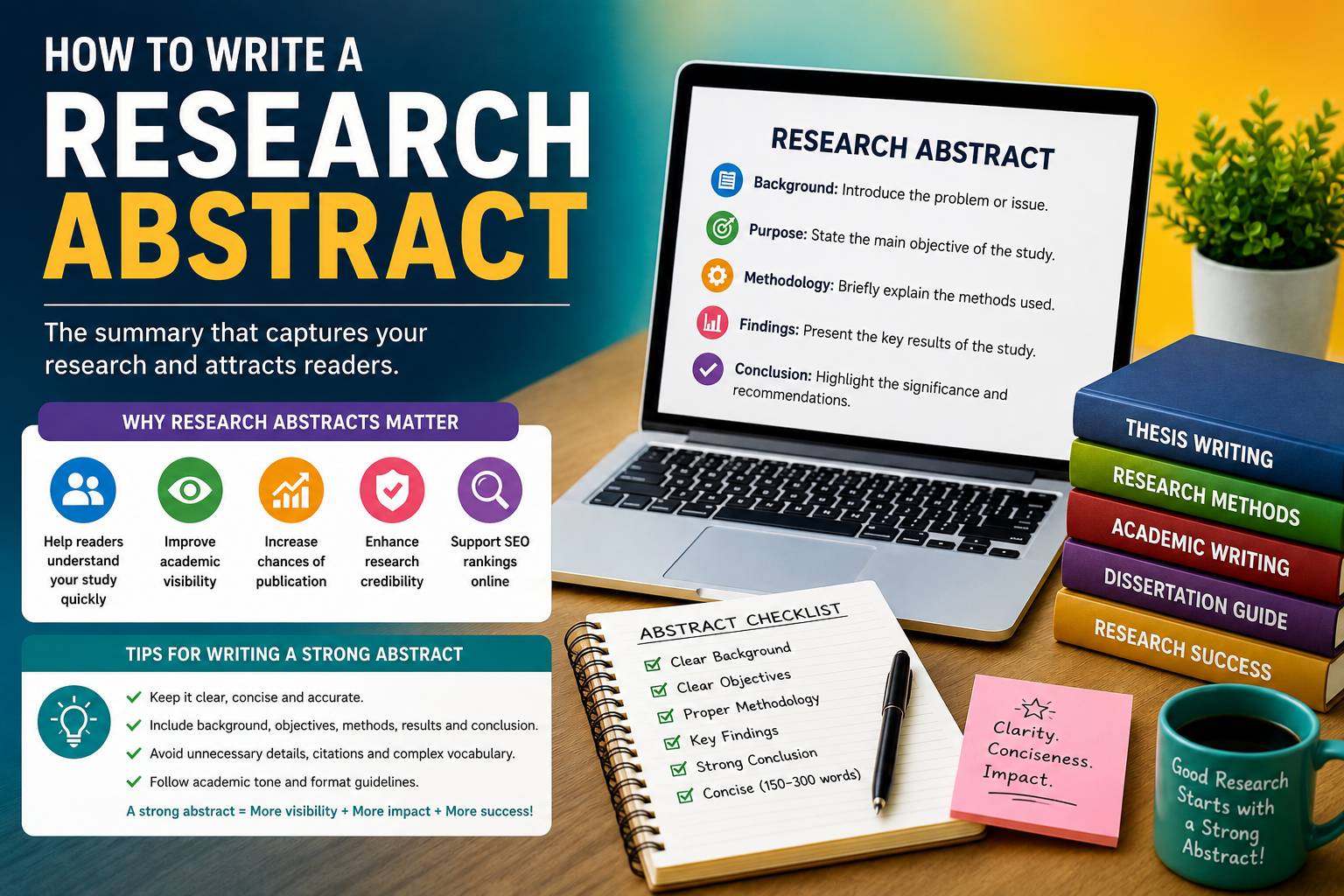
A research abstract is one of the most important sections of any academic project. Whether you are writing a thesis, dissertation, journal article, seminar paper, or research proposal, the abstract serves as the summary that gives readers a quick understanding of your work. In many academic settings, the abstract is often the first section people read before deciding whether the full research is worth their attention. Because of this, a well-written abstract can significantly improve the impact and credibility of an academic project, while a weak abstract can discourage readers from continuing further.
In academic writing, first impressions matter greatly. Supervisors, lecturers, journal reviewers, researchers, and conference organizers usually examine the abstract before reading other chapters or sections of the work. Within a few minutes, they often decide whether the research is relevant, organized, and academically valuable. A poorly written abstract may create the impression that the entire research project lacks quality, even when the study itself is excellent. For this reason, students and researchers must pay serious attention to abstract writing as an essential part of academic success.
A research abstract is a concise summary of a study. It briefly explains the research problem, objectives, methodology, findings, and conclusion. Although it is usually short, it contains the most important information about the research project. A strong abstract communicates the essence of the study clearly, professionally, and logically. Readers should be able to understand what the research is about, how it was conducted, and what was discovered without reading the entire document immediately.
Research abstracts are important for several reasons. First, they help readers understand a study quickly. Academic professionals often review many research papers within a short time, so they rely on abstracts to determine whether a study is relevant to their interests. A clear abstract saves readers time and makes the research easier to evaluate.
Second, research abstracts improve academic visibility. In today’s digital world, many academic works are uploaded to online journals, university repositories, and research databases. Search engines and academic platforms often display abstracts in search results. This means that a well-written abstract can attract more readers, citations, and academic recognition. Strong abstracts also improve Search Engine Optimization (SEO), making research more discoverable online.
Third, a quality abstract increases the chances of publication. Academic journals and conference committees often receive hundreds of submissions. Editors and reviewers may reject poorly written abstracts immediately, even before reviewing the full paper. A strong abstract demonstrates professionalism and increases the likelihood that the research will receive positive attention.
In addition, abstracts enhance research credibility. A properly structured abstract shows that the researcher understands academic writing standards and research organization. It reflects the seriousness and quality of the study. Students who learn how to write strong abstracts often improve their overall research writing skills as well.
Many students search online for terms such as “How to write a research abstract,” “Best abstract examples,” “Thesis abstract format,” “Research abstract writing guide,” and “Dissertation abstract tips.” These popular search terms show how important and challenging abstract writing has become in modern academic environments.
To write an effective abstract, students must understand its key components. One major component is the background of the study. The abstract should begin by introducing the issue, topic, or problem being investigated. This section gives readers context and explains why the research is important. For example, a study might begin with the statement: “The rapid growth of social media has significantly influenced communication patterns among university students.” This opening immediately introduces the topic and establishes relevance.
Another important component is the purpose of the study. Here, the researcher clearly explains the main objective of the research. Readers should understand exactly what the study intends to achieve. For example: “This study examines the effects of social media addiction on academic performance.” A clear purpose statement helps readers quickly identify the focus of the research.
The research methodology is also essential in an abstract. This section briefly explains how the study was conducted. It may mention whether the research used surveys, interviews, experiments, or qualitative and quantitative methods. For example: “A quantitative survey design was used to collect data from 300 undergraduate students.” This information helps readers understand the approach used to gather and analyze data.
Another key component is the findings or results. Many students make the mistake of discussing the topic without mentioning the actual outcome of the study. However, readers are usually interested in what the research discovered. For example: “The findings revealed a strong negative relationship between excessive social media use and academic performance.” Including results makes the abstract more informative and valuable.
The conclusion is the final component of a strong abstract. It briefly explains the significance or implications of the study. This section may include recommendations or highlight the contribution of the research. For example: “The study recommends balanced social media usage among students.” A strong conclusion leaves readers with a clear understanding of why the research matters.
Excellent research abstracts share several important characteristics. One of these is clarity. Abstracts should use simple and direct academic language that readers can easily understand. Complicated or confusing sentences reduce readability and weaken the quality of the abstract.
Conciseness is another important quality. Most abstracts range between 150 and 300 words, depending on institutional guidelines. Since abstracts are summaries, every sentence should provide useful information. Unnecessary details should be avoided.
Accuracy is equally important. Students should ensure that all information included in the abstract matches the content of the main research. Introducing ideas or findings not discussed in the study creates inconsistency and confusion.
Professional tone is another essential feature. Abstracts should maintain formal academic writing standards. Slang, informal expressions, and emotional language should be avoided.
Despite the importance of abstracts, many students make common mistakes during writing. One major mistake is including too much background information. Some students turn the abstract into a full introduction, leaving little room for objectives, methods, and findings. Since the abstract is only a summary, it should remain brief and focused.
Another mistake is including citations or references. In most academic formats, abstracts do not require citations because they summarize original research rather than review literature.
Using overly complex vocabulary is another common problem. Some students believe complicated language makes their writing appear more intelligent. However, academic writing values clarity more than unnecessary sophistication. Simple and precise language is usually more effective.
Failing to mention results is also a serious mistake. Readers want to know the outcome of the research. An abstract that discusses the topic and methodology without presenting findings feels incomplete.
An example of a strong abstract is: “Social media addiction has become a growing concern among university students globally. This study investigated the relationship between social media usage and academic performance among undergraduate students in Lagos State. A quantitative survey method was adopted using questionnaires distributed to 300 students across three universities. Findings revealed that excessive social media usage negatively affects concentration, study habits, and academic achievement. The study recommends awareness programs to promote responsible digital behavior among students.” This abstract clearly includes the background, purpose, methodology, findings, and conclusion in a concise manner.
In conclusion, a research abstract is far more than just a summary. It serves as a marketing tool for academic work and plays a major role in determining how readers perceive a study. A powerful abstract attracts attention, improves visibility, increases publication opportunities, and strengthens the professional quality of research projects. Students who master abstract writing significantly improve their chances of academic success, supervisor approval, conference acceptance, and scholarly recognition. By focusing on clarity, conciseness, accuracy, and proper structure, researchers can create abstracts that effectively communicate the value of their work to the academic community.